


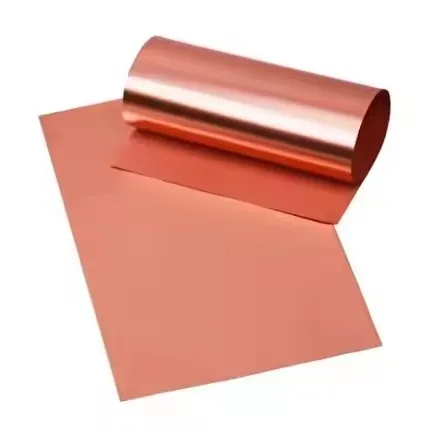
As a supplier of Copper Foil Plated With Nickel, I often encounter inquiries about the thermal conductivity of this unique material. Understanding the thermal conductivity of Copper Foil Plated With Nickel is crucial for various applications, especially in industries where heat management is a critical factor. In this blog post, I will delve into the concept of thermal conductivity, explore the thermal conductivity of Copper Foil Plated With Nickel, and discuss its implications for different applications.
Understanding Thermal Conductivity
Thermal conductivity is a fundamental property of materials that describes their ability to conduct heat. It is defined as the quantity of heat that passes through a unit area of a material in a unit time under a unit temperature gradient. In simpler terms, it measures how easily heat can flow through a material. Materials with high thermal conductivity, such as metals, are excellent conductors of heat, while materials with low thermal conductivity, such as insulators, impede the flow of heat.
The thermal conductivity of a material is influenced by several factors, including its atomic structure, density, and temperature. In metals, heat is primarily conducted through the movement of free electrons. Metals with a high density of free electrons, such as copper and silver, have high thermal conductivity. The atomic structure of a material also plays a role in determining its thermal conductivity. Materials with a regular atomic lattice structure tend to have higher thermal conductivity than those with a disordered structure.
Thermal Conductivity of Copper Foil
Copper is well-known for its excellent thermal conductivity. It has a thermal conductivity of approximately 401 W/(m·K) at room temperature, making it one of the best conductors of heat among common metals. This high thermal conductivity is due to the large number of free electrons in copper, which can easily transfer heat energy through the material.
Copper foil, which is a thin sheet of copper, retains the high thermal conductivity of bulk copper. The thinness of the foil allows for efficient heat transfer, making it suitable for applications where rapid heat dissipation is required. Copper foil is widely used in electronic devices, such as printed circuit boards (PCBs), heat sinks, and electromagnetic shielding, to manage heat and ensure the proper functioning of the components.
Effect of Nickel Plating on Thermal Conductivity
Nickel plating is a common surface treatment applied to copper foil to enhance its corrosion resistance, solderability, and mechanical properties. However, the addition of a nickel layer can have an impact on the thermal conductivity of the copper foil.
Nickel has a lower thermal conductivity than copper, with a value of approximately 90.7 W/(m·K) at room temperature. When a layer of nickel is plated onto copper foil, the overall thermal conductivity of the composite material is reduced. The extent of the reduction depends on several factors, including the thickness of the nickel layer, the quality of the plating, and the interface between the copper and nickel layers.
In general, a thin layer of nickel plating has a relatively small impact on the thermal conductivity of copper foil. As the thickness of the nickel layer increases, the thermal conductivity of the composite material decreases more significantly. However, even with a relatively thick nickel layer, the thermal conductivity of Copper Foil Plated With Nickel remains relatively high compared to many other materials.
Measuring the Thermal Conductivity of Copper Foil Plated With Nickel
Accurately measuring the thermal conductivity of Copper Foil Plated With Nickel can be challenging due to the thinness of the foil and the presence of the nickel layer. Several methods can be used to measure thermal conductivity, including the steady-state method, the transient method, and the hot wire method.
The steady-state method involves applying a known heat flux to one side of the material and measuring the temperature difference across the material. The thermal conductivity can then be calculated using Fourier's law of heat conduction. The transient method measures the time-dependent temperature response of the material to a sudden change in heat input. The hot wire method involves passing an electric current through a thin wire embedded in the material and measuring the temperature rise of the wire, which is related to the thermal conductivity of the material.
In practice, the thermal conductivity of Copper Foil Plated With Nickel is often estimated based on theoretical models and experimental data. These estimates can provide a good indication of the thermal performance of the material, but they may not be as accurate as direct measurements.
Applications of Copper Foil Plated With Nickel
Despite the reduction in thermal conductivity caused by nickel plating, Copper Foil Plated With Nickel still offers excellent thermal performance in many applications. Its high thermal conductivity, combined with its corrosion resistance and other desirable properties, makes it a popular choice for a wide range of industries.
One of the main applications of Copper Foil Plated With Nickel is in the electronics industry. It is used in PCBs to provide electrical conductivity and heat dissipation. The nickel plating helps to protect the copper foil from corrosion and improve its solderability, ensuring reliable connections between the components. Copper Foil Plated With Nickel is also used in heat sinks to transfer heat away from electronic devices, such as microprocessors and power transistors, and prevent overheating.
Another application of Copper Foil Plated With Nickel is in the battery industry. It is used as a current collector in lithium-ion batteries to improve the electrical conductivity and thermal management of the battery. The nickel plating helps to prevent the copper foil from reacting with the electrolyte in the battery, which can improve the battery's performance and lifespan.
Copper Foil Plated With Nickel is also used in the automotive industry, aerospace industry, and other fields where high thermal conductivity and corrosion resistance are required.

Conclusion
In conclusion, the thermal conductivity of Copper Foil Plated With Nickel is an important property that affects its performance in various applications. While the addition of a nickel layer reduces the thermal conductivity of the copper foil, the composite material still retains relatively high thermal conductivity compared to many other materials. The thermal conductivity of Copper Foil Plated With Nickel can be estimated based on theoretical models and experimental data, but accurate measurement can be challenging.
As a supplier of Copper Foil Plated With Nickel, I understand the importance of providing high-quality products with consistent thermal conductivity. We use advanced manufacturing processes and quality control measures to ensure that our Copper Foil Plated With Nickel meets the highest standards of performance and reliability.
If you are interested in learning more about our Copper Foil Plated With Nickel products or have any questions about thermal conductivity or other properties, please feel free to contact us. We are happy to provide you with detailed information and technical support to help you choose the right material for your application.
References
- Incropera, F. P., & DeWitt, D. P. (2002). Fundamentals of Heat and Mass Transfer. John Wiley & Sons.
- Touloukian, Y. S., & Ho, C. Y. (1970). Thermophysical Properties of Matter: Thermal Conductivity. Plenum Press.
- ASM Handbook Volume 4A: Heat Treating Fundamentals and Processes. ASM International.